The Iraqi Business Council.. A pioneering role adopting scientific visions & activating development partnerships reaping the benefits of the private sector support & qualifying it for diversification and innovation.
Prepared for Publication by : Suad Al-Shammari
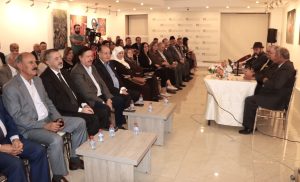
Amid a rich and inspiring atmosphere brimming with willpower and innovation, activities of the third closing session of the “Investment, Renewable Energy, and Finance Conference” that raised the banner themed “For A Sustainable Digital Future”, organized by the Iraqi Business Council, in partnership with the Jordan and Amman Chambers of Industry, the International Finance Corporation, and the Multilateral Investment Guarantee Agency, were quite successful.
The third session engaged in an extensive discussion on the role of financial technology and digital transformation toward innovative solutions to support investment, develop economic sectors, and advance electronic infrastructure. It also highlighted the importance of e-government and the valuable opportunities it provides, which raise the level of production and enhance trade exchange. It also highlighted the human resources it generates, capable of accelerating the pace of construction and achievement, enabling society to free itself from the constraints of routine and the specter of prevailing bureaucracy.
The distinguished guests of the session were prominent figures in their field of expertise, including Her Excellency Ms. Duha Abdul Khaleq, Executive Director of Eskandonia Software Company, Engineer Rula Amouri, CEO of Smart Professionals Company, and Mr. Atheer Ghassan Al-Qadi, representative of Amwal Electronic Payment Services Company. The session was also moderated by Engineer Nidal Al-Battar, CEO of INTAJ Association.
Rich debates and positive atmosphere prevailed during the session, yielding broad headlines lead by freewill and strong determination to strengthen bonds and shared values between Iraq and Jordan, achieving an integrative and participatory relationship representing the fruit of longstanding efforts exerted by both countries to reach a pivotal point to move off toward the world.. toward distinguished achievement and creative work.
————————————
Highlights:
– Amouri: Digital banks face greater security challenges than traditional banks, and artificial intelligence is taking on the task of protecting them.
- Abdul Khaliq: We are implementing digital transformation projects with distinguished Iraqi partners and are seeking to support the private sector in both countries.
– Abdul Khaliq: We have found effective Iraqi administrative leaders who believe in digital transformation and are moving forward toward beneficial partnerships with Jordan.
– Abdul Khaliq: It is time to ease restrictions on the movement of money in the Iraqi market to achieve the desired smoothness in trade and development.
– Al-Qadhi: Iraq has a solid infrastructure for electronic payments, banking, and human resources.
– Al-Qadhi: The volume of Iraqi electronic collections reached approximately $5.8 billion in 2024 and is expected to double in the coming years.
– Al-Qadhi: What Iraq needs now is to develop a national strategy for the digital economy.
- Al-Qadhi: Iraq’s economy is a single-rent economy, and diversifying investment within the framework of technology is a necessity that requires determination to implement it.
- Al-Barzanji: It is my duty to facilitate granting entry visas for Jordanians to Iraq, as there are high prospects interpreted by the narrative of the historical relationship with Jordan.
——————————-
(INTAJ) Association.. A wise Royal vision & an umbrella brimming with innovation.
Hence, the beginning of (INTAJ) Association, which represents a broad umbrella for information and communications technology companies in the Hashemite Kingdom of Jordan. (INTAJ was established in 2000 on the foundation of a wise Royal vision for the Kingdom to become a major regional center in the fields of communications, information technology, entrepreneurship, and innovation. Through this, significant achievements have been made in the information and communications technology sector in Jordan, in terms of increased exports, employment, and various companies that have spread beyond the region.
—————————
Security Challenges.. between financial technology and the capabilities of digital banks.
The path to achievement is not void of obstacles or restrictions that limit ambition or restrict freedom of choice, especially with regard to some of the security challenges facing digital banks, controlling their work mechanisms or breaching their foundations of protection.
In this regard, and based on her work and experience, Eng. Rula Amouri, CEO of BST Cyber Security, heads the Jordan branch of the Armed Forces Communications and Electronics Association, and holds a master’s degree in management information systems from the American University in London.
Mrs. Rula says that digital banks, due to the nature of their work, provide online services and rely on a great deal of advanced technology. They face more security challenges than traditional banks, amongst which fraudulent access to the individual’s information and security breaches. These are the most prominent challenges facing banks, in addition to digital identity theft or the theft of customer’s digital identity or customer’s data through various methods for the purpose of making incorrect and unauthorized financial transactions.
Another challenge could be vulnerabilities in the programs and applications provided by banks, such as mobile application programs on banks’ websites. The mere presence of any A vulnerability in these applications could create a vulnerability and lead to hacks. Furthermore, digital banks, which are a chain of suppliers and technology provided by multiple parties, are vulnerable to attacks and hacking attempts aimed at accessing any loopholes in the bank’s private information.
Therefore, we face challenges that demand from us to overcome or transcend them through the use of artificial intelligence. Today, artificial intelligence represents power, action, and will, and reliance on it is increasing day by day in the field of cybersecurity, even in predicting and determining the possibility of security breaches. This means that any breach has become subject to the control of artificial intelligence, especially since banks secure their customers using multiple authentication methods, including fingerprints and other procedures.
Another procedure followed by banks in the field of artificial intelligence is the encryption of customer information, which must be encrypted in a modern and accurate manner. This is one of the means and tools that help banks protect the security of correspondence, making it extremely difficult or impossible to obtain. Furthermore, today, everyone relies on behavioral analysis and how it is used in applications.
————————————
Digital Transformation Projects.. true partners in quality achievement.
Ms. Duha Abdul Khaleq, a legal expert in the Information Technology and Insurance sectors, a businesswoman, and a former member of the Jordanian Senate, says:
As a founding partner of Askadenia Software Company since 2000, that is, since the founding of (INTAJ) Production Association, I can confidently say that we have had early experience working in the Iraqi market since the second millennium. We have worked in the telecommunications sector in Kurdistan for a long time, and today we have several digital transformation projects with distinguished Iraqi partners in the Communications and Media Commission, and we have worked in AP systems.
In short, we are carefully examining the technological content of industries and finding local alternatives in the form of exportable goods.
Therefore, as part of the Association of Telecommunications and Information Technology Companies (INTAJ), the sectoral association that promotes high-tech companies at the national level, these issues are common to both markets. This includes building relationships, opening markets, regional cooperation, encouraging investment in the sector, and participating in conferences to work in Iraq.
Our mission today is to work together, side by side, as teams from Iraq and Jordan, and to work on what can be implemented in a practical and beneficial way for both parties. From this political will, joint cooperation began to enable coordination and integration between the two markets, especially in the last two years, which have served as a workshop for more than twenty years.
Freedom of Trade.. effective Iraqi leaderships changed the dynamics of the new reality.
Freedom of trade, or the four freedoms of trade, and working mechanisms based on integrating the Iraqi and Jordanian markets in a way that benefits both parties.
Mrs. Duha continued, saying; “Initially, I encountered previous impressions that the market was divided, there was quotas, and that it was difficult to deal with. However, this impression has completely changed with administrations focused on economic prosperity and the presence of effective administrative leaders who believe in digital transformation and are moving forward towards creating beneficial partnerships with Jordan. We have witnessed this in the banking sector and outstanding companies, such as technology and automation companies, regarding the free movement of goods.”
“Regarding fees and taxes, we generally have two principles. We believe in the principle of reciprocity, with a win-win outcome for both parties. This is a golden rule. The second principle is the automation of goods movement procedures. This is our role in the immediate collection and recording phase.”
“We are talking about an uninterrupted supply chain, an automated chain from the user’s perspective.”
“Given the political reasons that have led to excessive oversight of financial flows in Iraq, we believe today that time has come to ease some of the restrictions on financial flows in the Iraqi market to achieve smooth flow of money for the purposes of trade and development.’
All these challenges require working on building success relying on the previous steps by employing the ideas of consultants and providing them with expertise, along with the role of legal experts, new technology ideas, and integrating technical universities into the hospitality, hotel, and insurance sectors. The project is a brainstorming session aimed at finding products and practical steps that can be implemented. And while we’re talking about Iraq, let’s not forget the creative sector; books, publishing, writing, internet, cinema, crafts, arts, and women’s sector products, among others. All of these require comprehensive data management and transfer processes to electronic media to disseminate the largest number of creative works as merchandise on the web.
———————————
Electronic Payment Services.. a necessity seeking implementation and dissemination.
Significant challenges face electronic payment operations in Iraq and the foundations of electronic transactions in modern commercial transactions, which save time and effort and provide the security required in new commercial transactions policies. Here, Mr. Atheer Ghassan Al-Qadi, from Amwal Electronic Payment Services Company, tells us about the company’s beginnings and its role in the field of electronic payments in Iraq since 2008. He also tells us about being the first to introduce the (Master Card) and (Visa) to Iraq by defining the operating protocols for these companies to emulate Iraqi banking systems and provide electronic payment services to the commercial sector and individuals.
Mr. Al-Qadi summarizes the factors hindering Iraq’s adoption of more electronic payment services, stating that the digital economy is no longer an option, but rather a necessity that must be implemented as quickly as possible. He goes on to say that if we examine Iraq’s economy and its resources, it is no secret that the Iraqi economy to this day, despite the presence of investments in many sectors, is a single-rent economy, and the Gross Domestic Product (GDP) comes mostly from oil and gas exports. This poses a significant risk to the country’s economy in the future, as it is subject to fluctuations in global oil prices, which could put the country in financial distress at some point. Therefore, diversifying investments in all fields is required, particularly in the field of technology of all kinds, mainly the financial technology, because by the nature of its work, all investments will inevitably be linked to the digital economy.
Therefore, the existence of a digital economy will link all types of investments to contribute to the national product regarding electronic payments in Iraq. Especially in recent years, there has been a very noticeable development in terms of infrastructure and electronic payments, particularly regarding the infrastructure of the Central Bank of Iraq, in addition to banks and payment companies, in terms of the human competencies that promise to manage these systems now and in the future.
Let’s talk numbers and give an example of the volume of electronic payments in Iraq in 2024. The volume of electronic government collections was approximately 8 trillion Iraqi dinars, equivalent to approximately $5.8 billion. This number is expected to increase and double in the coming years, possibly reaching approximately $30 billion by 2026.
——————————–
Safe investment operations mean innovative digital banking solutions.
The process of developing safe, innovative, and practical digital banking solutions is subject to many standards, requirements, and management expertise. Here, Engineer Rula cites a successful experience from her work in Iraq, saying, “We started in Jordan in 2010, moved to Dubai in 2011, then to Iraqi Kurdistan in 2012 and Baghdad in 2013. We worked with various official Iraqi entities, such as the Ministry of Information Technology, the Ministry of Housing & Construction, and several banks in the field of electronic development and training.”
“Therefore, I concluded that investing in human resources is one of the most important gains that achieve better returns, given the presence of greater capabilities that can participate in development, progress, and future plans. From my personal experience and experience living in Iraq, I find that focusing on cybersecurity is one of the most important topics we must pay great attention to, whether in terms of developing legislation, laws, regulations, and instructions in line with international guidelines. This is one area, but in addition, it includes cybersecurity applications, especially with regard to the Market (Souk) Center, which is a security operations center. Through it, all transactions conducted by a ministry, government agency, or bank can be monitored, thus predicting or preventing any potential security breaches.”
“I believe that political will exists in the financial sectors, particularly in the insurance solutions sectors, microfinance, and banking sectors which require oversight by the Central Bank. This means that automation is always present with us, and solutions can be implemented if the will and speed factors are present for implementation.”
———————————–
Electronic Payment.. free space and fluctuations in the global system
Regarding the known challenges in the field of electronic payment, Mr. Atheer Al-Qadi affirms that this field always has an open ceiling, as there are no restrictions on payment instruments or payment methods. The world relies on specific payment methods subject to the global system.
In general, Mr. Atheer Al-Qadi asserts that there are local payment solutions that could be innovative and implemented in any country, ranging from the currently accepted e-wallet to other payment methods that could be programmed and introduced to the market, particularly regarding digital currencies. These methods lack clarity, and there is no international or local legislation to govern the operation of these currencies. Therefore, it is currently difficult to adopt digital currencies in payment systems, at least locally, in countries. Perhaps in the future, when there is official recognition of these currencies, they will be included like other payment methods.
Iraq & Jordan.. a creative partnership and hopes for mutual success.
The historical relationship between Iraq and Jordan cannot be summed up by a single project or title, but rather by a long series of achievements that faced complexities and obstacles before reaching the core of its existence, the precision of its composition, and its solidity.
In this regard, His Excellency the Iraqi Ambassador to Jordan, Dr. Omar Barzanji, spoke about his short experience in the Hashemite Kingdom of Jordan, saying, “I have been in Amman for a short time, and I have experience in several countries, including Lebanon, Romania, the Vatican, and Qatar, in addition to working at the Ministry’s headquarters as an Undersecretary. However, this conference was a unique experience, and I am filled with joy and pride with this cooperation and joint work existing between Iraqi and Jordanian businessmen and others. I feel that there are great prospects awaiting us in this relationship. I assure you that since my arrival in Jordan, I have felt it is my duty to facilitate the issue of entry visas to Iraq, because I am eager to see Iraqi and Jordanian businessmen head to Iraq to work in this field. I see it as a blessed step that yields positive results stemming from the presence of competent figures, with their interventions and lectures, who represent the backbone of all countries. We wish the best for Iraq and Jordan, and for the entire Arab and Islamic world. Indeed, we hope that goodness will prevail among all.”
——————————
With these spirits and the courageous efforts of the daring men, whose visions are embraced by the Iraqi Business Council who seek to bring viewpoints closer together and open the doors to constructive action, new features are taking shape, invading Iraq’s economic landscape, transforming it from a monotonous, classical pattern to a creative developmental renaissance. This renaissance could mark a milestone and establish a solid foundation for partnership that keeps pace with the demands of the current era and rescues the country from the trap of stereotypical repetition and reliance on limited-horizon wealth leading it toward a new world brimming with diversity, competing with the world’s capabilities and potential through a vision based on sifting ideas and harnessing the horizons of science and technology, with solid expertise and competencies eager to achieve, excel, and innovate without limits.